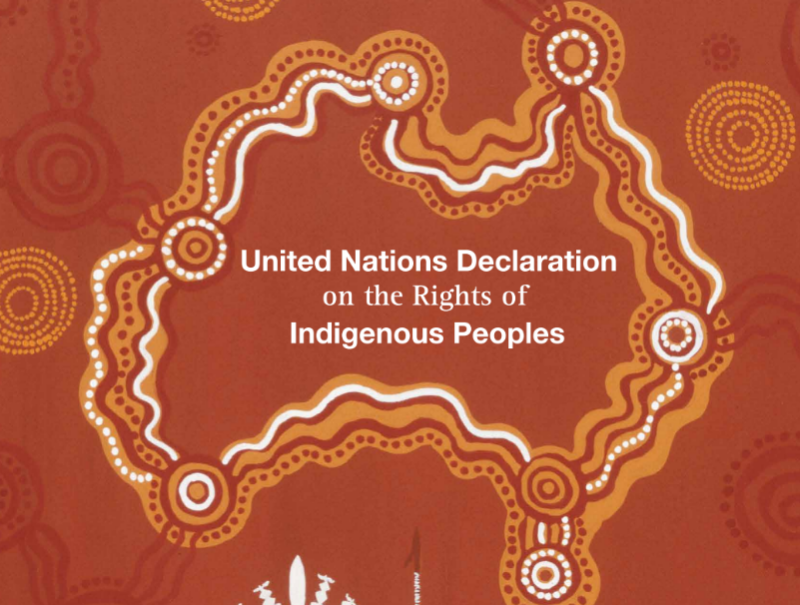
UNDRIP TREATIES SIGNED BY AUSTRALIA 

The Declaration can be a powerful tool to protect rights, drive change and build a more equal future for Aboriginal and Torres Strait Islander people.

About the Declaration

The United Nations Declaration on the Rights of Indigenous Peoples (UNDRIP) is the most comprehensive international instrument that recognises and protects the rights of Indigenous peoples globally.

Adopted by the UN General Assembly in 2007, the declaration sets a universal framework for respecting, protecting and fulfilling the rights of Indigenous peoples.

These fundamental and foundational human rights can be categorised into four key principles:

  • Self-determination.
  • Participation in decision-making.
  • Respect for and protection of culture.
  • Equality and non-discrimination.

United Nations Declaration on the Rights of Indigenous Peoples 

Core Articles


Article 3 – Self-determination
Indigenous peoples have the right to freely determine their political status and pursue development.


Article 4 – Self-government
Right to autonomy in internal/local affairs.


Article 8 – Protection from assimilation
States must prevent destruction of culture and identity.


Article 10 – No forced removal
No relocation without free, prior and informed consent (FPIC) and compensation.


Article 18 – Participation in decision-making
Right to be involved in decisions affecting them.


Article 19 – FPIC requirement
Governments must consult and obtain consent before adopting laws/measures affecting Indigenous peoples.


Articles 25–28 – Land and resources
Rights to:


Maintain spiritual relationship with land
Own, use, control traditional lands
Redress/compensation for dispossession


Article 29 – Environmental protection
Protection of lands and resources from hazardous activities.


Article 32 – Development and resource use
FPIC required before resource development on Indigenous lands.Core Articles


Article 3 – Self-determination
Indigenous peoples have the right to freely determine their political status and pursue development.


Article 4 – Self-government
Right to autonomy in internal/local affairs.


Article 8 – Protection from assimilation
States must prevent destruction of culture and identity.


Article 10 – No forced removal
No relocation without free, prior and informed consent (FPIC) and compensation.


Article 18 – Participation in decision-making
Right to be involved in decisions affecting them.


Article 19 – FPIC requirementGovernments must consult and obtain consent before adopting laws/measures affecting Indigenous peoples.


Articles 25–28 – Land and resources
Rights to:

Maintain spiritual relationship with land
Own, use, control traditional lands
Redress/compensation for dispossession


Article 29 – Environmental protection
Protection of lands and resources from hazardous activities.


Article 32 – Development and resource use
FPIC required before resource development on Indigenous lands.

International Covenant on Civil and Political Rights (ratified)

Key Articles

Article 1 – Self-determination

All peoples (including Indigenous) can determine political status and control natural resources.

Article 2 – Non-discrimination obligation

Rights must be ensured without discrimination.

Article 26 – Equality before the law

Prohibits discrimination, including racial discrimination.

Article 27 – Minority cultural rights

Indigenous peoples can:

Practice culture

Use language

Practice religion

International Covenant on Economic, Social and Cultural Rights (ratified)

Key Articles

Article 1 – Self-determination

Includes control over natural wealth and resources.

Article 11 – Adequate standard of living

Includes housing, food—relevant to land dispossession impacts.

Article 12 – Health

Right to physical and mental health.

Article 13 – Education

Must respect cultural identity.

Article 15 – Cultural rights

Right to:

Take part in cultural life

Protect cultural heritage

RightsConvention on the Elimination of All Forms of Racial Discrimination (ratified)

Key Articles

Article 1 – Defines racial discrimination

Article 2 – Obligation to eliminate discrimination

Includes reviewing laws and policies.

Article 5 – Equality in rights

Covers:

Property ownership

Participation in public life

Access to services

Convention on the Rights of the Child (ratified)

Key Indigenous-Specific Article

Article 30 – Indigenous children’s rights

Indigenous children have the right to:

Enjoy their culture

Practice religion

Use their language

Convention on the Elimination of All Forms of Discrimination Against Women (ratified)

Relevant Articles

Article 2 – Eliminate discrimination against women

Article 14 – Rural women

Important for Indigenous women:

Land access

Participation in development

Living conditions

Convention on the Rights of Persons with Disabilities (ratified)

Relevant Articles

Article 5 – Equality and non-discrimination

Article 21 – Freedom of expression (includes language)

Article 30 – Cultural participation

Protects cultural identity, including Indigenous persons with disabilities.

The 7 Core UN Treaties Australia HAS ratified

LAW OF NATIONS 

The development of international law (the "law of nations") was profoundly shaped by Hugo Grotius, Samuel von Pufendorf, and Emer de Vattel. Their works moved international law from a purely theological basis to one rooted in natural law, reason, and state practice, establishing the foundation of the modern state system.

Hugo Grotius (1583–1645)

Often referred to as the "father of international law", Hugo Grotius was a Dutch jurist who created a framework for international law based on natural law and the practices of "civilized" states.

  • Key Work: On the Law of War and Peace (De jure belli ac pacis, 1625).
  • Key Ideas:
    • Natural Law as Basis: He argued that law is based on reason and human nature, holding true even if it were to be assumed that God does not exist.
    • Pacta Sunt Servanda: He emphasized the sanctity of treaties and good faith in international relations.
    • Law of War: He sought to restrict the legality of war and establish rules for its conduct.
  • Context: His work was pivotal during the early 17th-century, preceding the Peace of Westphalia, setting the stage for sovereign state interaction.

Emer de Vattel (1714–1767)

Emer de Vattel was a Swiss jurist and philosopher whose work popularized the principles of the law of nations, particularly in the American colonies, during the 18th century.The National Constitution Center

  • Key Work: The Law of Nations (Le Droit des Gens, 1758).
  • Key Ideas:
    • Natural Law Applied: Vattel focused on applying natural law to the conduct and affairs of nations and sovereigns.
    • Sovereign Equality: He pioneered the idea that all sovereign states are equal, regardless of their size or strength.
    • Sovereignty and Independence: He detailed the rights of states to self-preservation and the corresponding duties, making it a "law" that states could follow in practice.
  • Impact: Vattel’s work was widely used by 18th-century statesmen to justify sovereignty, and it influenced early American law and diplomacy.

Samuel von Pufendorf (1632–1694)

Samuel von Pufendorf was a German philosopher and jurist who developed the "natural law" framework further by focusing on the societal aspect of international law.

  • Contribution: Pufendorf challenged some of Grotius's ideas, arguing that natural law is solely based on the requirement of social existence.
  • Sovereignty: He developed the idea of the state as a "moral person" (persona moralis) and argued that international law only exists between independent sovereign states, not between individuals in the state of nature.
  • Role in International Law: Pufendorf is key for defining the state as an independent entity in a "state of nature" relative to other states.

Beyond the ordinary